No Surprises in Baseline Transport Study Report
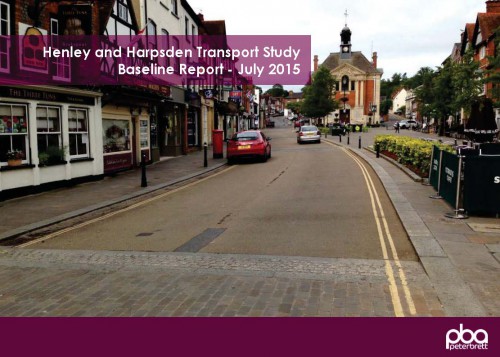 A Baseline Report for the Henley and Harpspden Transport Study has been published by Consultants, Peter Brett Associates after they undertook the study for six weeks in June and July for Henley Town Council as part of the Joint Neighbourhood Plan.
The study was carried out using automatic number plate recognition, Manual Traffic Counts at 10 key junctions likely to be effected by the additional 450 houses and Automatic Traffic Counts at 22 key locations to understand the daily traffic flow, profiles and speed along the road.
The key objectives of the study were:
- Assess the travel demand of the proposed 11 new housing sites and identify how this demand can be accommodated, supported by the town centre traffic modelling and in a way that meets the following objectives;
- Reducing congestion and the impact of traffic in Henley-on-Thames and Harpsden including that caused by HGVs;
- Enhancing the walking and cycling environment and making these modes more attractive, including a review of pedestrian crossings;
- Enhancing public transport services and access and making these modes more attractive; and
- Identifying localised capacity enhancements where this meets the objectives above
There were no great surprises in the Baseline report – more houses, means more transport issues with the largest number of journeys in and out of the biggest proposed housing site at Highlands Farm on Greys Road with 140 houses.
The report does though outline the number of vehicles coming into Henley over a 24 hour period through 3 main routes and the number of HGVs:
- Over Henley Bridge 9154 vehicles (409 HGVs)
- Along the Fairmile 6317 vehicles (355 HGVs)
- Along the Reading Road 5881 vehicles (242 HGVs)
No surprise too that during a site visit to Henley and Harpsden, the following congestion issues were observed during the AM peak hour:
- Vehicles queue from the traffic signals at Henley Bridge along the A4130 back to Remenham Church Lane.
- Traffic queue from the Town Centre along the A4155 back to the Esso Garage.
- Coaches and HGV were observed mounting the kerb along the A4155 to physically travel southbound past the stationary traffic queue.
- LGVs and HGVs were identified as causing some serious congestion in the town centre when loading or delivering particular driving in peak periods. Lay-bys do not always accommodate the size of the vehicle and private cars often use the loading bays and prevent use for loading.
As a result of these queues and delays, there is suspected to be a certain amount of rat running traffic through residential areas of Henley.
The report continues “Greys Road car park becomes congested as a result of through traffic between Greys Road and Market Place, as it provides an alternative southbound route to Thameside and Deanfield Avenue.” However I think most people use this as a cut through to go up Greys Road?
Figures reported show the potential increase areas of traffic from the new housing sites (both am and pm) are on Greys Road (6-19%), St Marks Road (16-20%) and Duke Street (10.7%). Not sure why there would an increase in St Marks Road when none of the developments are in this area or would be used as a cut through to.
The report also covers other modes of transport and highlights the following:
- The pedestrian section of the report identified four example locations where footways are narrow in the town centre although Friday Street was not one of these.
- Public transport highlighted that there was no direct bus service to Reading Railway Station and only one local bus operator runs after 1700 hours in the peak after work hours. They didn’t though highlight that there was no direct bus service to Oxford
- There are limited cycle routes and facilities within Henley and Harpsden.
Councillor Will Hamilton, Chair of the Transport Study Committee said, “The first stage was to do the Baseline Report and the second stage was to run the stakeholder workshops (like Supermarkets/Businesses/ Key Residents Groups and Henley in Transition) which we did last week. The consultants will take the input from key stakeholder groups, and with the input from the Baseline traffic study and together we will start looking at the different traffic modelling options.”
“One of our key priorities since the election is to sort out the traffic in Henley as best we can, and particularly the flows over the bridge into and out of Henley. This data for the first time gives us a view on the weight of traffic in Henley and how it flows, where it comes from and where it goes to. It gives us data on the number of HGVs both stopping in Henley, and travelling through Henley. It is also gives the impact that 450 houses would have on the town and its impact at the pinchpoint at Lower Greys Road for example. Over the next few months we will work with our consultants to come up with better solutions, based on this data, and then work with our colleagues at OCC to prioritize those that will improve the situation.”
To read the full report click here