
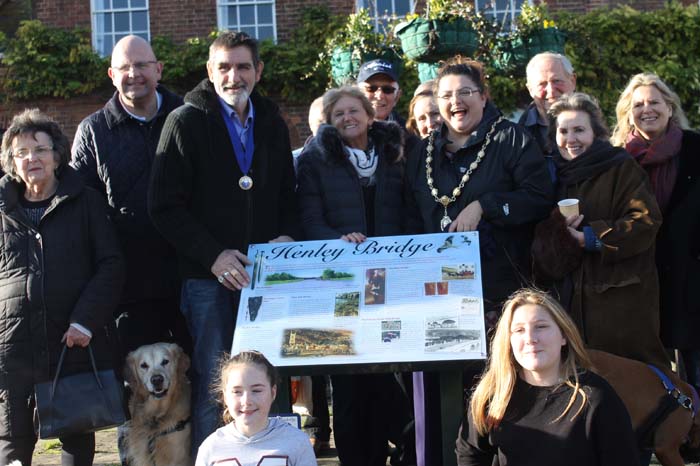
History of Henley Bridge Plaque Unveiled
A fourth Henley historical plaque was unveiled on Saturday at Singers Park, Thameside detailing the history of Henley bridge.
The plaques were idea of Henley Town Councillor, David Eggleton with the first one being installed in 2015 at the entrance to the Gainsborough Estate about the inventor Humphrey Gainsborough. The other plaques are about Makins Recreation Ground on Greys Road and the Henley Obelisk at Mill Meadows. Research for all the plaques has been carried out by Viv Greenwood who is a member of the Henley Henley Archaeological and Historical Group.
The new plaque charts the history of the bridge starting with the first flint and stone bridge being built circa 1190 which was crucial to the success of the town as an inland port, trading with an ever expanding London population and includes a Jan Siberechts’ 1698 painting showing the 12th century bridge with a wooden bridge either end of the arches. The plaque goes on to detail the history of the existing bridge which was built in 1786 after a loan of £10,000 from Parliament, the background to head carvings and the impact on the railway coming to Reading in 1840 which crippled the river trade. Over the years the bridge has stood up to being damaged many times through wars, flooding and in recent years by boats and lorries with the plaque detailing the latest damage at this year’s Regatta by a lorry which knocked out one of the stone pillars into the river.
Viv Greenwood said, “Creating the Henley Bridge plaque was difficult in that there is too much information out there. Each separate paragraph had to be mercilessly edited, otherwise it would have been solid text with no room for illustrations. For example, more could have been written on the the archaeologically important Palaeolithic site at Highlands Farm, at the top of the town. Did the Atrebates actually invite the Romans to Britain to quell the troublesome Catuvellauni tribe? Was the Anglo Saxon wharf also used to transport flint for the building of Reading Abbey? Was the 12th century Henley bridge multi arched, then partially demolished because bigger barges were needed to trade with London….and that’s just a few!
“The next plaque will hopefully be based on the 1698 Siberechts painting ‘Henley from the Wargrave Road’, which is in the River and Rowing Museum. It would be great to work more closely with the brilliant museum curators and highlight this landscape, siting it close to the water on the Mill Meadows towpath, with a Henley view that is startlingly similar, yet subtly different.”
Henley Mayor, Councillor Kellie Hinton said, “I am really pleased with this initiative. What started as a heritage sign at Gainsborough has now spread throughout the town, helping to educate visitors and residents on our own Henley Heritage. Thanks as always to David and Viv for their hard work in making these plaques happen. The question has to be – where next? I’m excited to find out!”
Councillor David Eggleton said, “The plaque looks brilliant. We have a lot of positive feedback about the other plaques and and I think it’s important that we carry on with the project so that people understand how Henley became the town it is today.”

Click to Enlarge


