

Notable Historic Henley Builder and Mayor’s Headstone is Restored
The grave headstone of Charles Clements, six-times Henley Mayor and notable Henley builder who died a 100 years ago has been restored this week after a local resident found it broken in the summer after researching him.
Resident Dr Michael Redley, who teaches History at Continuing Education Department at Oxford University discovered the headstone after researching him for a talk for the Henley Archaeological and Historical Group Zoom talk in September to mark the centenary of his death. Michael said, “I live in Henley in a house which Charles Clements built in Norman Avenue, which was his particular project, and I did all I could to understand how he had been involved and what lay behind it. This led me to look into the building of the town, from which it emerged just how much Clements had contributed. Much of my department at the University has been shut down over the last year by Covid, so I turned to local history instead. I am hoping to publish eventually a set of essays on the Victorian and Edwardian town.”
Henley Mayor, Councillor Ken Arlett, listened to Michael’s talk in September and was saddened to see the photo (below) of the headstone in such an abandoned state. Ken commented, “This fella was born into a really poor family and made it on his own. He became a builder and built some of the noteworthy buildings in the town. Most of the Councillors back then were from the landed gentry. He became a formidable 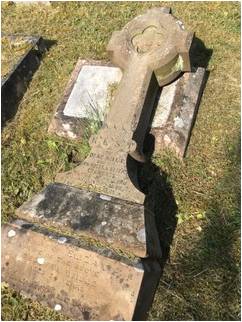 Councillor and Mayor and strengthened the town’s health, wealth and education including a sewage system which replaced the wells and cesspits. Henley probably wouldn’t be today without Charles Clements. I thought that this fella deserves his headstone to be restored and made enquiries with stonemasons ET Sheppard.”
Clements is best known for his buildings which include Barclays Bank in Hart Street, the intriguing “gothicky” villas in Norman Avenue and the shops and offices on the corner of Greys Road and Reading Road with beetling and fine detailing. Most ambitious was the massive and intricately detailed mansion, Friar Park, which he built at the top of Gravel Hill and West Hill for the wealthy city solicitor and financier Frank Crisp. His restorations and extensions included St Mary’s and Holy Trinity churches and the parish church at Fawley.
Perhaps his oddest creation, also on a hill, was the reconstruction of Henley’s regency town hall. In 1898 he won the contract to demolish the old one to make way for the new and carted the building up Remenham Hill to Crazies Hill, where it still stands as a private house, named after the village, and faces the rising sun, as it did in Market Place.
His last big building job was to oversee the construction of the new United Reformed Church in Reading Road, which was completed in 1908.
Michael explained, “After researching Clements for my house, I found his obituary notice in a local newspaper, and worked back from that to where he was buried. The Council office which runs the Fairmile Cemetery kindly supplied me with the location of his grave, and I went to find it. I have also written a ‘walk’ of the town focused on Clements’ life, which takes in the headstone.”
Ken added, “Originally I thought this would be an easy project and one that I would use some of my Mayoral allowance this year for. It turns out though it was a bit trickier as the headstone, even though in 3 parts, were all really heavy and needed lots of Park Services team manpower and a fork lift to move it. We left the original base in the ground thinking that ET Sheppard would attach the other pieces to it, then they said we needed to bring that piece too! After trying with a long crowbar we eventually got the base out!”
On seeing the restoration, Ken said, “Thank you to ET Sheppard who have done the work and shared the cost. It was well worth all the work in the end to see it back to its former glory. It’s sad to see other fallen headstones in the cemetery but the cost of restoring all of them would be big money. I have talked to Michael though about researching all of the former Mayors so that we have record of them all. At the moment many of the photos in the Council Committee room are just faces and names that no one really knows about.”
Michael commented, “The Council has done an excellent job. The headstone has been well restored and looks fine. As a local historian, I am personally delighted. Clements was a huge local figure in his day. The hope is that physical memorials will lead to an increased interest the town’s more recent history, not least in Victorian and Edwardian times when it developed into the town we have today.”
The last part of the restoration is to repaint the black lettering which will be done in the Spring.
Michael is doing a talk for the Oxfordshire Architectural and Historical Association on 12 January, entitled “At the centre of the world: Henley and the Olympic Regatta of 1908.” To book a place go to https://oahs.org.uk/lectures.php
The words on the headstone which mark the graves of Charles, his wife Eliza and his son Willie are:
REST
TO DEAR WILLIE
Son of
Charles and Eliza
Clements.
Rested in the Lord,
January 29th 1889,
aged 18 years
Also of Charles Clements,
Honorary Freeman of Henley on Thames
Died September 18th 1920
In the 76th year of his age
The finger of God touched him and he slept
Also of Eliza,
Wife of the above
Died April 11 1922
Aged 74 years
A life’s work well done


