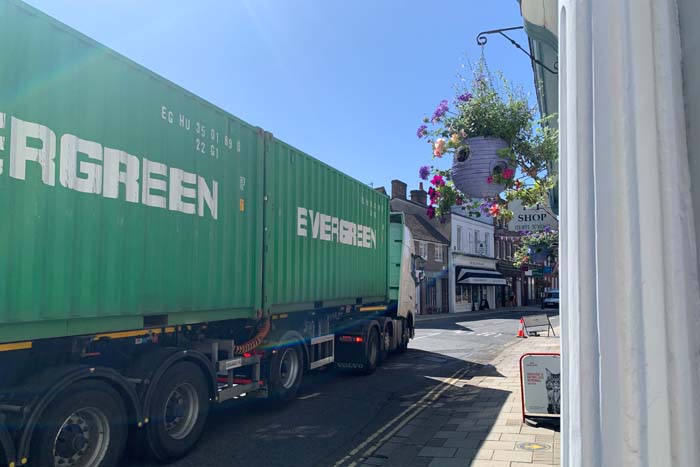
HGV Campaigners Write to Strategic Transport Lead at Oxfordshire County Council
Campaigners behind introducing a 7.5T weight restriction to Henley have sent a formal letter to Joseph Kay, Strategic Transport Lead at Oxfordshire County Council (OCC) last week and attached photographic evidence of HGVs causing problems in Henley. OCC are currently reviewing the Local Transport Connectivity Plan (LTCP) and have produced a baseline report.
In the letter it says, “The Baseline Report attached to OCC’s agenda (Item 6) which was considered on the 19 January 2021 seemingly makes no reference to the problems of HGVs cutting through Henley. This is in marked contrast with paragraph 17 of the document published by OCC entitled “Connecting Oxfordshire: Local Transport Plan 2015 to 2031.”
Paragraph 17 states, “Deter use of inappropriate minor roads through towns and villages. The county council will consider environmental weight restrictions across the County, particularly areas which are subject to significant levels of HGV traffic, prioritising the towns of Burford, Chipping Norton and Henley-on-Thames.”
The letter continues, “Since this document was prepared, independent traffic surveys have shown that the number of HGVs using Henley has ballooned. In 2015 the Peter Brett study showed that HGVs then represented just 2% of the traffic flow but contributed 20% of the NOx pollution. Observation of the A4130 now would suggest that majority of vehicles are commercial and a substantial number of these are aggregate trucks and large HGVs that are clearly just using the town only as a river crossing. The creation of the Portway Link and development of distribution centres in and around Didcot have also boosted the volume of traffic using the A4130 considerably.”
“These operate 24/7 disturbing the sleep of residents by causing the many homes that line the route (many of which are listed and date back as much as 600 years and do not have modern foundations) to vibrate violently as these heavy vehicles pass at speed, invariably flouting the 20m.p.h. speed limit. In daytime hours pedestrian safety is jeopardised when these huge vehicles often mount our pavements in order to negotiate the sharp narrow 90 degree turns between ancient buildings, which are the result of the medieval layout of this town.”
“Henley has been designated an Air Quality Management Area since 2007. The NOx levels have remained above the legal limits and in December 2020, during lockdown restrictions, we exceeded that limit 18 out of the first 22 days. Clean Air for Henley has visited all the Primary Schools in Henley and found that in general 20% of the children already use inhalers. This is traffic related and impacts especially the primary school children at Rupert House School in Bell Street on the A4130. Increasing numbers of HGVs, small lorries and vans make drop off and pick up times quite intolerable. In addition, these children have to walk to and from their Sports Ground along the Fairmile (A4130) and their parents who walk to and from school often have small children and babies with them.”
“In addition, we now have the growing realisation that microscopic particulate matter does a great deal of harm to our health. The latest research and the case of Ella Kissi Debrah should be ringing alarm bells everywhere. We in Henley are concerned about these particulates that especially diesel vehicles bring into our town. The residents and shopkeepers on Bell Street (A4130) would welcome the opportunity to show you how much black deposit quickly builds up on our window sills within a few days of being cleaned. The thought that we are actually breathing this into our lungs is terrifying.”
The letter highlights the campaign petition which has 2,300+ signatures online and a further 350 signatures on a hard copy.
Henley Town Council and South Oxfordshire District Council are behind this proposal. The cost to introduce this would be £100/£120K for the necessary traffic studies, the Traffic Regulation Order and signage which would be funded by Henley Town and/or local parish Councils.
Joseph Kay replied to the letter saying, “The LTCP baseline report has been published in support of the LTCP vision document and is an analysis of high level countywide data. As such the document does not identify any locally specific issues such as those you have highlighted in Henley. The vision document is the first stage of updating the LTCP and seeks to establish the high level direction for transport in the county. The vision will ensure that we have outlined a clear long-term ambition for transport in the county and will underpin all the policies included in the LTCP document.
“More detailed work on the LTCP and accompanying evidence base will be conducted as we develop the detailed LTCP and supporting documents. This work will commence following public consultation on the vision document.
We welcome your feedback on the vision document as part of the consultation which will commence in mid-February.”