
Trinity Students Riveted By Mike Willoughby’s WWI Artefacts
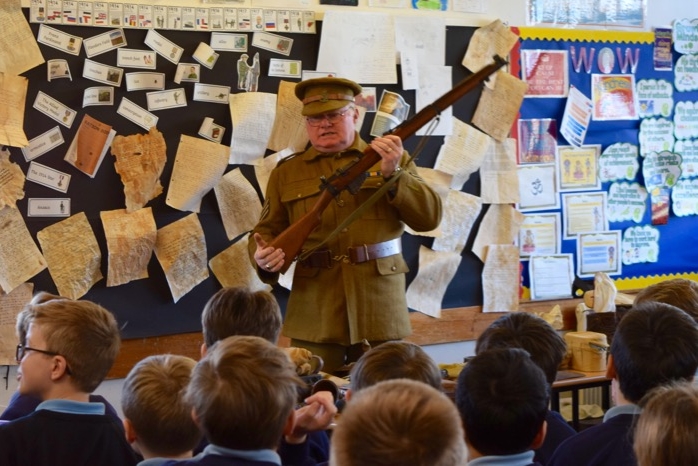
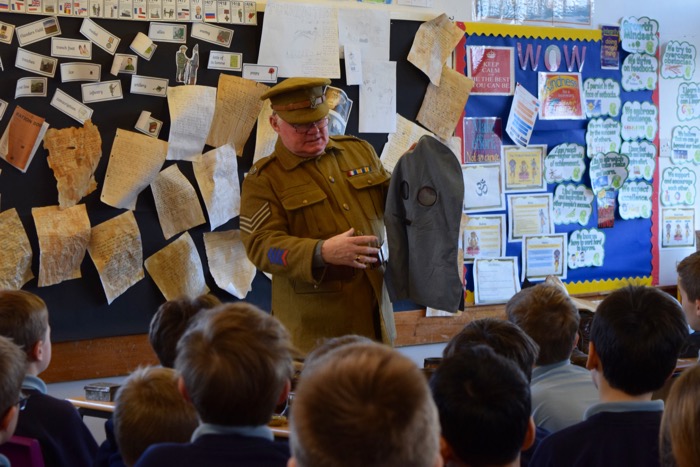

Year 5 and 6 students at Trinity Primary School rounded off their World War I curriculum with a visit from Henley’s Lest We Forget project founder, Mike Willoughby. Last Tuesday afternoon, Mike gave a presentation to the 90 fascinated children, bringing with him a number of artefacts and stories about life in the trenches.
The Trinity students have been learning about World War I for the past four weeks as part of their creative curriculum. As part of their studies, they have read Michael Morpurgo’s ‘War Horse’, created their own propaganda posters, and written imaginative, empathetic letters from the perspective of soldiers in the trenches.
Mike Willoughby’s visit drew their focus on WWI to a close with a meaningful and informative flourish. After a month of learning about the realities of life in the war, the students came into contact with genuine artefacts and replicas of objects that Tommy would’ve used. Mike showed them examples of weaponry and tools used by the soldiers, including a knife, a grenade, an entrenching tool, and a short magazine Lee Enfield rifle with bayonet.
Mike himself was dressed for the occasion in a replica WW1 soldier’s uniform, with a helmet and boots laid out on the table amongst his many other artefacts. The everyday existence of Tommy was discussed as Mike talked the children through the contents of Tommy’s backpack: food rations, a toothbrush, razor, shaving brush, and ‘housewife’ (sewing kit) amongst other items. The students were particularly intrigued when presented with an unusually shaped metal stick which Mike revealed to be a brass button polishing guard, designed to protect a soldier’s uniform when polishing.
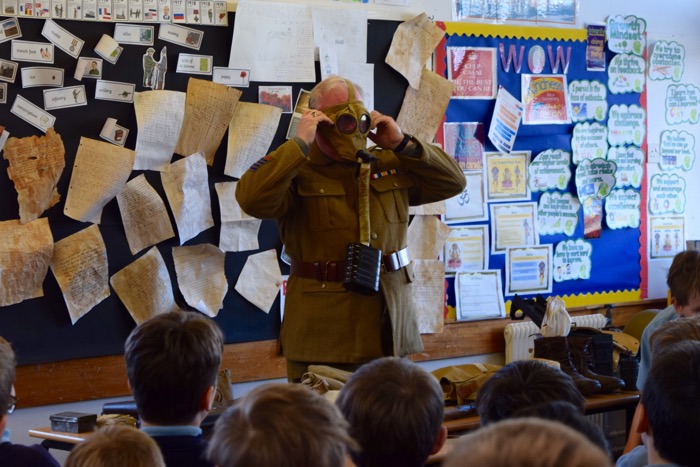
A less benign collection of objects demonstrated the evolution of the gas mask. As Mike explained, when the German’s first used gas in April of 1915, the soldiers had nothing for protection so would use urine-covered handkerchiefs. To disgusted cries from his audience, Mike responded, “It’s war, and the alternative was to choke. I don’t know if you’re heavily into war poetry […] but the descriptions of poison gas are most effective.” Mr Willoughby then produced an improved ‘smoke hood’ before revealing a full face respirator, which to the delight of the class, he put on.
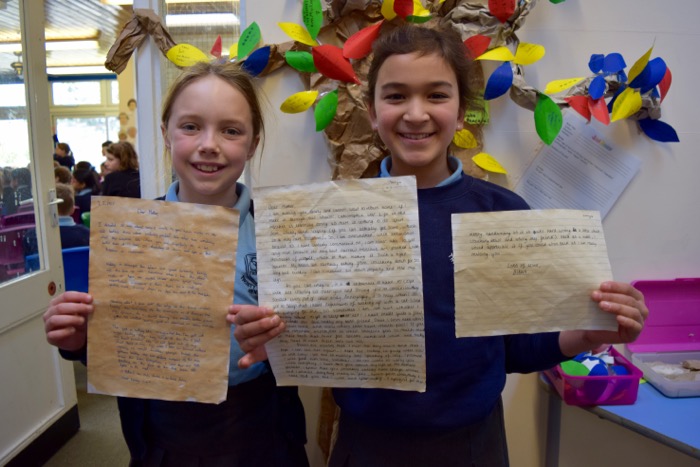
Some of the children brought in their own World War I artefacts to share with Mike: letters sent by their great-great-grandfathers. Juno had with her a letter from her great-great-grandad, a soldier in France, written to his seven year old daughter on her birthday. The letter was also sent with a gift: a silk handkerchief. Year 5 student Phoenix, too, had a letter from his great-great-grandfather, describing that he had been shot by a shell but was unhurt (his collar had been up), and that he had kept the shell as a souvenir. Phoenix said about Mike’s presentation, “I learnt what they used to go over the trenches with. I learnt what they used to build the trenches and get out of trenches.”
Although not all of the children had genuine letters from WWI to show, each of them had written descriptions of the war from the imagined perspective of a soldier. The finished pieces, written on tea-stained pages to look like old letters, were moving and sensitive. The striking work of Year 6 student, Henry left a lasting impression on his teacher, Mrs. Williams. “In all honesty, in all the years I’ve been teaching I have never read something quite as powerful as what he’d written,” she said. An excerpt from Henry’s writing can be found below.
Mike Willoughby’s book, ‘Bringing Them Home’, which details the 298 Henley serviceman who died in WW1, was a great piece of source material for the children, and many of them have been reading it in break times. Mrs. Williams was thrilled with the students’ response to Mike’s presentation. “It fascinates them, you can hear a pin drop,” she said. “It’s wonderful to hear their questions as well, they’re truly interested. He’s been very kind to share his artefacts with the children.”
The Year 5 and 6 students will be learning about WWII next half term, and after the success of his last visit, there is already talk of bringing Mike back to talk about the next book he is researching on WWII soldiers.
Henry’s Creative Writing
Putrid, horrible, disgusting; everything was dreadful. Littered around me were the dead remains of those whom once, a long time ago now, would’ve been my friends. Crowded in the damp, dark trenches I listened. Listened to the persistent rattle of machine gun, the heavy footsteps of those brave enough to keep going, the shouts from one of many demanding officers. All of which just made it worse, worse than ever before. Terror rose in my throat like an uncontrollable darkness as once again I peaked over the top of the deep trench, trying desperately to pick off one of Jimmy’s innocent men. A fact which made me cry in my boots for the evil of what I was doing. But I wasn’t the only one. On the other side of No Man’s Land the same things were happening. Undoubtedly, the Germans were thinking the same, too. It was inevitable that the screams were the worst of it all. They cut the air like daggers, coming from everywhere and everyone. It was terrifying.
The trenches that we were living in were like hell. Just hell was better. Mud and water went up to our knees, filling our boots and giving us the most vile Trenchfoot known to man. The skin around our toes became rotted and our feet got numb with the chill. One of the only things we can do is chop off our own toes. To do this though, we’d have to take our boots off, a routine which many of us couldn’t bare to endure. The lice are a disturbance we could all do without, the constant itching and scratching ruins the short moments of peace that we get, moments that really should be cherished. It would help if the trenches themselves were bigger, many a time we would find ourselves getting a claustrophobic feeling. Petrified, I’d often imagine the walls of the trenches closing in, squeezing out my lungs and crushing my brain.


