
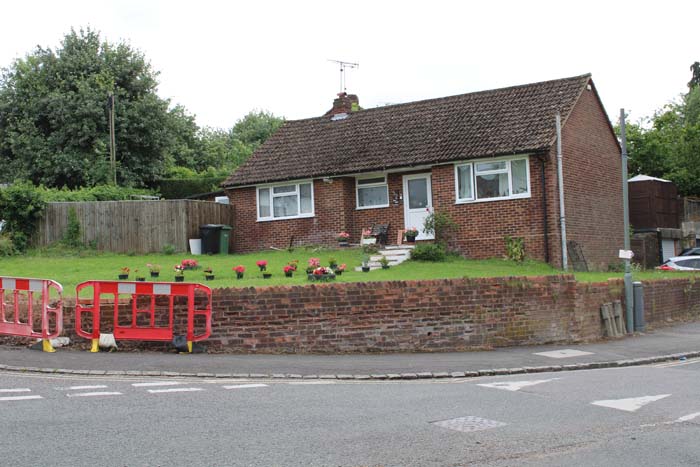
Appeal Dismissed on Refusal of Bungalow Development
A planning application for the demolition of the bungalow at 52 Greys Road (pictured above) and the erection of three 2 bedded terrace cottages and two 2 bedded two storey flats has which was recommended for refusal by Henley Town Council and refusal by South Oxfordshire District Council has lost its appeal to overturn the decision.
The application site would also use land at number 54 for the development but the existing bungalow at no. 54 would remain and the development would include the provision of 6 on site parking bays (4 partially enclosed).
Alexander O’Doherty from The Planning Inspectorate states in his report that the main reasons for dismissing the appeal were that the plans were out of character and appearance of the surrounding area; the setting of the Henley Main Conservation Area; and parking and highway safety.
The report goes on to say “The appeal site comprises a detached bungalow with a set of garages to its rear. The bungalow represents the last dwelling on this side of Greys Road, up to the junction with Deanfield Avenue, which lies in front of the site. The site occupies the central position at the junction, and views of the site are possible near the end of Greys Road. Thus, the appeal site is in a very exposed and prominent location,”
“The proposal would entail the addition of 3 residential units, over-and-above that which exists. As such, the intensification of the use of this prominent corner site would be substantial. This level of activity, including from comings and goings and vehicle movements (including delivery vehicles), and the use of the private amenity areas, would unduly contrast with the more modest levels of residential activity nearby.”
“The appeal site is immediately adjacent to the Henley Main Conservation Area (conservation area). The conservation area’s significance as a designated heritage asset, as whole, includes its historic buildings which exhibit a high standard of architectural design and fine craftsmanship. The setting of the conservation area includes those areas in close proximity to it, including the appeal site, which are part of the surroundings in which the heritage asset is experienced. The setting, including the appeal site, contributes to the significance of the conservation area by providing a soft transition between the presence of period architecture within the conservation area and the other non- statutory designated land beyond.”


