
Rowing Master Breaks Another World Record


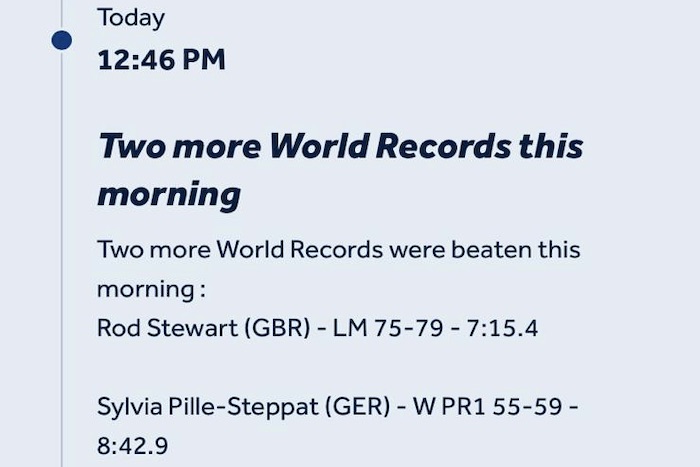
Upper Thames Rowing Club’s Rod Stewart (pictured centre above) competed in the World Indoor Rowing Championships last weekend where he smashed the current masters world record by just over 8 seconds. The 2000m event was held virtually under strict conditions with competitors from all over the world racing within three areas – Rod being in the Europe and Africa region. Racing in the lightweight 75-79 masters age group, the rowers competed on ergos (indoor rowing machines) that were linked up to laptops, sending and receiving live race data for those in each race.
Rod competed, over looking the river in the Upper Thames gym, surrounded by cheering supporters and ably supported by 4 friends (Mark Williams from Mosman Rowing Club, Australia, Lee Brown, Helen Mangan & Paul Stuart-Bennett, all from Upper Thames), who all took turns on a next-door ergo so that Rod had support and someone to keep a rhythm with. Rod said, “It was great to have my friends with me, helping to keep me focused as the race got tough. It’s much nicer to be out on the river in a boat, but at this time of year, when the weather is bad and the river is often on red boards, the ergo is a good challenging substitute.”
Rod, who was born in Australia, first began rowing when he coxed age 14. By 16 he was too big to continue coxing and so picked up the oars. In 1977, he earned a Bronze medal in the World Championships and continued to row until he was 29. Having moved to England, he rowed on and off also having periods of time on horseback and bike. After a serious cycling accident in the velodrome where Rod’s hip replacement was smashed, he returned to rowing and hasn’t looked back. Now aged 75, he has just won his second world record in his masters age group.
“Rowing is a very technical sport that takes years to master to a high level – technique doesn’t leave you but conditioning and strength plays a part and it becomes more tricky to maintain as you get older. I train every day and race all around the world from Amsterdam to Australia,” explained Rod. He went on to explain that the indoor format is hard. The distance is the Olympic distance and usually, at masters level, the races are 1000m (rather than 2000m) so it is physically challenging – but without a team in a boat, it becomes a mental challenge as well.
Rod first broke a world record 5 years ago when he turned 70. Since then, he set himself the goal to restart the ergo training and planned and trained to take the record again. Rod had recorded a record breaking time before Christmas at the British Championships, so he knew the record was achievable. For this event, he had to submit a predicted time and ended up within a second of what he thought, which demonstrates just how scientific a process the training is and how accurate the training programmes are.
Rod added, “There is a real sense of personal satisfaction in achieving the world record. I thought about it for a long time and planned and trained for achieving the world record. It’s an enjoyable journey and making it happen is special. I told people I knew I could break the record, not because I am bigheaded but because it was my commitment to the challenge and an important part of the motivation to deliver. The most nerve wracking part was ensuring that all the pre-race checks were passed and the network connection to the internet was alright for the whole race! That’s it for the ergo indoor racing now…I think…but I will definitely continue to race on the river.”
To watch Rod’s final 500m:



Leave a Comment
Want to join the discussion?Feel free to contribute!