
Largest Literary Festival celebrates ten days of stories, stars and inspiration
The largest Henley Literary Festival ever closed yesterday to big applause with over 120 events over 10 days.
This year’s Festival saw a top line-up of speakers from politicians to comedians, sports personalities to Sunday Times bestselling authors at in-person talks at Henley Town Hall, Phyllis Court Club and The Relais hotel as well as online. A large school programme saw children’s authors attend including Children’s Laureate Frank Cottrell Boyce, MC Grammar and Dermot O’Leary. Joanna Lumley opened the festival and former England cricketer Phil Tufnell closed it along with best-selling poet Donna Ashworth.
Henley Literary Festival Director, Harriet Reed-Ryan said, “I am delighted by the festival this year – the audience numbers seemed brilliant across the whole festival. We need to finalise numbers but am hoping it will be record breaking. It was the most diverse festival with subjects covered from history to politics to children’s events and big celebrity names as well as emerging writers. Not only did we have great audiences in Henley but thousands of children joined online and we furthered our free care home online viewing. Bring on 2026!”
Below are a few reviews from this year’s programme.
Graham Norton: From Chat Show Host to Master Storyteller

Graham Norton’s appearance at the Henley Literary Festival was everything you’d expect smart, self-deprecating, and wickedly funny.
Talking about his latest novel Frankie, he began by asking if anyone had read the book, spotting a lone hand at the back. “One person back there – they knew this day would come and they knew they were going to get a copy today,” he quipped.
Frankie tells the story of an elderly Irish woman who slowly reveals her past to her new carer, Damian. The novel follows Frankie’s life from Ireland to London, across to New York and back again. Norton explained that he’s always drawn to having female characters, “Women have to navigate life more so than most men,” he said. “Men are quite simple creatures. He quipped, “Man over there doesn’t know what I’m talking about…I’m starting the car!” Women have to second guess things, adapt in a way that men don’t do. If they encounter something, that doesn’t suit them they go I’m not doing this, I’ll go over and do that.”
Despite being one of the UK’s best-loved broadcasters, Norton’s novels remain firmly rooted in Ireland. “I’d never have the nerve to set a novel in the UK,” he admitted. “Kitchens in Ireland are all I know about.”
He spoke about his earlier failure of becoming an actor, recalling that twelve years ago he got his original dream of an acting role in the West End. He said, “I enjoyed it, but after four or five months I realised this wasn’t my dream anymore. I went back to my chat show life thinking I’m much better at that than this.”
Growing up as a Protestant in Ireland, Norton reflected on feeling “slightly odd” and detached. “I thought my oddness came from being Protestant, but when I left Ireland, I realised it was something else!” he said, grinning.
Norton’s love of storytelling was rooted early. He grew up surrounded by tales told around the kitchen table or while driving with his mother, who would point out houses and share the stories behind each one.
The conversation inevitably turned to being famous and the longevity and his long-running chat show. “Back in 1998, there were people we would have killed to have on the show – now we’d run them over in a car and no one would arrest us,” he joked. “That’s the vagary of fame. I’ve had a much bigger slice of the pie than I should have.”
He was as candid about the perils of live broadcasting. The Eurovision Song Contest, Norton admitted that “being witty is more dangerous these days.” He recalled an early comment about a larger lady from Malta. He said I said, ‘apparently, she’s very friendly, she’s never met a Malteser she never liked’. He said he’d never say something like that now. Adding nowadays, “It forces you to say cleverer things – and that’s no bad thing.”
During the audience Q&A, Norton revealed that he would love to have Brad Pitt or a young royal on his sofa (Kate or William), though a rumour about Prince Harry once got him excited in the press – until he discovered he’d leaked this himself.
Asked if he still gets starstruck, he confessed: “All the time. I can’t imagine not being starstruck. Julia Roberts is lovely and you can imagine her putting the kettle on.” Tom Cruise however, “I can’t imagine him doing that or using any other appliance. He’d stare at a tumble dryer like it had landed from space. He never cleans the filter.”
As ever, there were anecdotes from The Graham Norton Show, including Mark Wahlberg’s infamous overindulgence of alcohol and whether he knows the red chair story beforehand. Remarking “No it is hardest to fain interest once!”
If Norton ever does retire from television, he joked, he might call his next book Burning Bridges. Judging by the warmth, laughter and admiration in the Henley audience, that seems unlikely anytime soon.
Alan Davies: Behind the Comic Mask
Comedian and actor Alan Davies brought a mixture of emotion, honesty and vulnerability to Henley Literary Festival as he discussed his memoir White Male Stand Up. Opening with a wry quip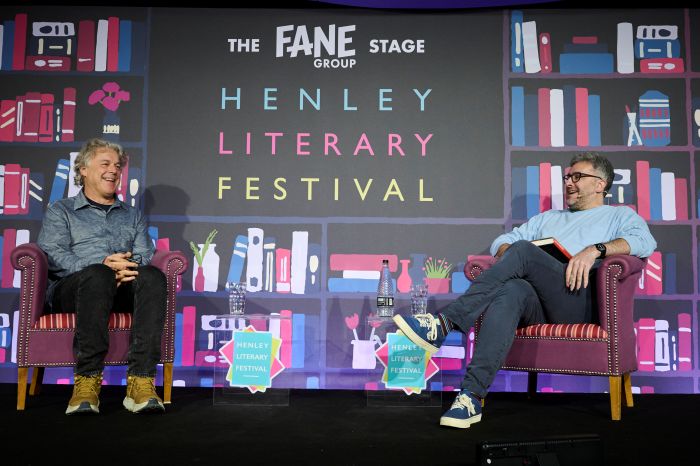 “Never been to Henley before, I rowed here” he quickly set aside easy humour to reflect on the more painful chapters of his life. Much of the talk centred on his childhood trauma: losing his mother at the age of six and suffering abuse from his father. It was moving, if more sombre than some in the audience might have expected.
Best known to many as the unflappable detective Jonathan Creek and for his 23 years on QI, Davies was quick to brush off any suggestion he’s retained the show’s encyclopaedic trivia. “Don’t ask me about the facts,” he joked, “they go in one ear and out the other.” But what he does hold on to are the friendships forged: Stephen Fry, Jo Brand, Sean Lock, Bill Bailey “it was like being in a school year together,” he said. He described QI as “intellectual soft play,” with researchers spending months building knowledge fields for him and his fellow panellists to mischievously wreck.
His career, however, has not been a straight line. Early stand-up led to adverts (“I caved at the first offer—I had no backbone!” he admitted, recalling a heckle about his perm after fronting Abbey National ads), TV panel shows, and eventually a long absence from live comedy. Jonathan Ross once told him, “I think you’re scared to go back to stand-up.” Davies, then busy with QI, resisted the charge, but eventually realised Ross was right. Now, after ten years away and a pandemic-sized delay he is returning to the stage.
Davies was open about the painful threads running through his life and how writing the book was like “therapy” and had helped his wife and their children. He said, “Comedy helped turning that anger upside down”.
He talked about improving his writing by doing a Masters at 50 at Goldsmiths, however admitted that his first writing was “rubbish.”
Davies revealed that a year ago whilst writing the book he was diagnosed with bladder cancer, discovered during a cystoscopy. He recalled that when everyone went out of the room for a minute, he retrieved his glasses so he could see the big TV. Afterwards, “The atmosphere changed in the room.” The cancer was removed successfully, and he counts himself “unbelievably lucky.”
There was some light relief a however when talking about guests on QI. Davies retold the story of John Sessions impersonating Richard Burton and Elizabeth Taylor in a hotel argument, and relished swapping memories of QI’s “toffs against oiks” line-up.
Looking ahead, Davies expressed interest in writing comic fiction like Spike Milligan who is an inspiration but ruled out further memoirs. His career, he reflected, has been a patchwork of unexpected turns, from Jonathan Creek to the Jonathan Ross Show, from panel games to radio, from celebrity to isolation. Fame, he noted, is curiously disconnecting “You present different faces to different people. No one really knows you.”
Davies gave his audience a rare glimpse behind the comic mask, revealing the man shaped by loss, resilience and humour. It was a moving and memorable encounter with the real Alan Davies.
Inspiring climate conversation in partnership with Greener Henley

For the first time at this year’s Literary Festival, there was a Greener Henley partnership event which saw two leading voices on environmental and social change: Tony Juniper, leading environmentalist and author of Just Earth, and Sangeeta Waldron, award-winning communications expert and author of What Will Your Legacy Be?
Tony Juniper’s Just Earth delves into how inequality stands as one of the greatest barriers to climate progress, while challenging us to build a fairer, more sustainable world and Sangeeta Waldron’s What Will Your Legacy Be? amplifies voices from NASA scientists to indigenous leaders, urging communities to act now.
Sangeeta reminded the audience that every small act counts: “Every action is worthwhile. You might think you’re not making a difference, but you are. All these little actions create a ripple effect, and these ripple effects create a tsunami of change.”
Tony emphasised the need to connect grassroots movements across sectors: “The emissions keep going up….and the reason that the emissions keep going up is that we’ve not changed the basics of what countries are doing because we haven’t yet convinced enough people, and so building this grassroots infrastructure, connecting it up, getting it out of its little green silos, joining it up with other social movements linked with health, with poverty, with education, with sport… that’s how we’re going to get change…. Because once we can do that, this becomes unstoppable. And this is the moment that we must do it.”
The conversation covered a wide range of topics all connected in some way to the climate and nature emergency – from indigenous wisdom, the military and conflict, unexpected bedfellows such as finance and insurance, to the importance of bees and power of community action.
Dermot O’Leary: Spy Fox and Agent Feathers – A schools event
 As well as being a well established household name in the television, radio & entertainment industries, Dermot O’Leary is also an established children’s author. He delighted and entertained the gathered groups of school children on the Fane stage, as well as those online – as far north as Mansfield, with his stories and explanations.
O’Leary explained that he had grown up surrounded by stories. With an Irish father who told him tales passed down from his grandfather, his earliest memories were of, “wearing the itchiest tops in itchyland”, and going to the library with his dad on a Saturday. He’d confided he’d always wanted to be an author and when he first got hold of paper, he’d started to write his own chapter books. As a little entrepreneur, he decided he could sell them and much to the amazement of the children gathered, he explained that he did so to neighbours for a massive 5p…the equivalent of 5 penny chews!
Interviewed by Kirsten O’Brien, he told the children about how he loves animals and so wanted to start writing about them. His first series, a set of 6 books, were all based on his rescued kitten Toto. With only 10% sight, Toto relied on his other senses and soon developed superhero skills, causing him to be dubbed Little Ninja – giving Dermot the idea for the books. As part of the Ancient order of Ninja Cats, whose chief is Larry the chief mouser at 10 Downing Street, Toto solves various mysteries and crimes. “The beauty of writing the stories yourself is that you can create your own little worlds around them,” he explained.
“I also love history and I really wanted to write about World War 2. I decided that it would be really fun if the animals were fighting the war too but the humans didn’t know. In my first book, Wings of Glory, I created the Royal Bird Force…like the Royal Air Force, but for birds.”
Dermot’s latest book came from a combination of his love of Roald Dahl’s Fantastic Mr Fox and the fact that he wanted to write a a spy novel. He explained to the children that he needed a sneaky but clever animal as his main character, so he chose a fox. He then needed a side-kick, but he wanted it to be funny, so he decided that he would make her a chicken – usually known for being the enemy! When asked at the end by one of the children, which character was his favourite, he first of all feigned shock that it was like choosing between your children…although he eventually confessed that he thought Gertrude, aka Agent Feathers, was a genius who didn’t like fighting – and perhaps we should all be more Gertrude!
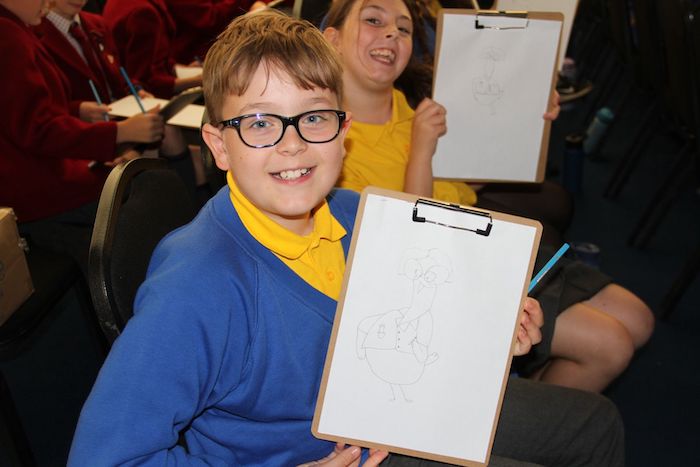
As part of the show, Dermot’s illustrator instructed the children how to draw Agent Feathers via a video to which they were all able to draw along on clipboards. Mia, from Charvil Primary School said “I really enjoyed doing the drawing, it was brilliant – I love how mine turned out!” In the Q&A section, the children asked a number of business style questions which impressed the author, leading him to believe there were a number of budding authors in the room. From “How long did it take you to write the book?” – 2 months on 3 mornings a week (he’s more of a morning person!), to “How long do you plan for?” – a couple of days, even if you don’t stick to it (much to the delight of teachers who try to get children to plan!) to “What is the time from start to finish?” – It takes about 9 months from planning to having a printed copy in my hands.
As the event drew to a close, Dermot confided that, when he started writing, he wasn’t sure he would have enough ideas to to write more than 1 book, however, once he got going he found he had plenty and they just keep coming. In fact, he now wants to come up with an idea based in Norway, where his Norwegian wife comes from. Through out the show, Dermot had the children entertained, involved and enthused. Lysander and Juliet, both from Rupert House, had been reading the book in class before coming. Lysander said “I really like the code breaking – it was brilliant trying to work out what the codes meant.” Juliet said “I’ve really enjoyed listening to Dermot, he’s really funny. I liked doing the drawing too and I really like the characters he creates.”
Dame Denise Lewis, Adaptability – 7 lessons to thrive in a world of competing demands
In an inspirational conversation with Jendella Benson, former Olympian and athletics pundit, Denise Lewis explained she was “…Buzzing to be here. I was out there behind the curtain and had to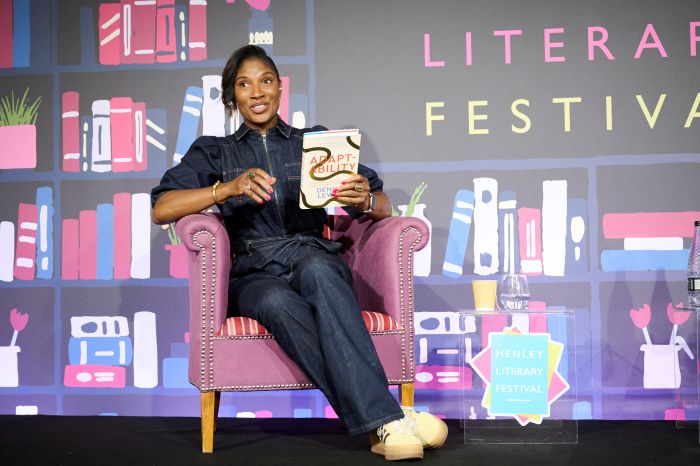 check that people had actually come! Fear had gripped me – it’s like letting my baby out into the world for the first time.”
For many years, Denise Lewis was a sportswoman, competing at 3 Olympics, commonwealth games and other major sporting championships. She trained and worked hard; won medals, but when she finished her sporting career, that’s when she had to learn how to do life. She had been in a structured world with obvious goals and also a world dominated by men. Brought up by a strong single mother with a just get on with it attitude, Denise developed a game face. For the last decade, she’s been juggling many things: a career, motherhood, deep self-reflecting moments and, despite all the tools that sport had given her, at times life was hard.
“Women are told that they can do everything, have it all, but I don’t think that’s actually true. You have to pace yourself. I burnt out by over-training and over-giving and I got to a point where I realised I needed help. My book is an honest deep dive into me and my identity, about taking back control and the lessons I have learned along the way.”
Denise and her mum were a team and it was her mum that instilled values into her: The importance of routine, discipline and the need to work hard…that is how you move forward, Denise explained. “I really believe nothing happens by accident. All we go through shapes us and what happens to us, so we have to find ways to do what we do. But I always come back to my values. They have definitely shaped me. People will make you doubt yourself, or focus on negatives, but I know that I am a good person and my values are intact – so sometimes I have to say, it’s a them problem, not a me problem.”
She also went on to explain some of the learns that she has found – most of which were taken from her sporting career:
1) Hard work pays off
2) Routine is good for you…although you can’t always get other people to follow yours!
3) Trust your instincts – and learn to listen to them
4) Set your own parameters – you have to know when you are full…Sometimes you need to step off the wheel for a moment and reconnect with yourself before you disappear.
Seeking and accepting help when you need it is also important. For Denise this came from her network – sporting mentor Sue Campbell, her mum, other competitors, her girl gangs and even the school mums. “You think you have to be strong but sometimes you have to show a bit of vulnerability and let people in – show your true self. That way you build trust and your safety network strengthens.”
In the final questions, amongst other things, Denise was asked what she would tell her younger self – a common question to her. Her reply was “Don’t worry so much about what other people think of you. You have to own your space and do things as well as you can. If you are proud of yourself then it gives others the confidence to feel the same.”
Photo credit: Scarlett Page




Leave a Comment
Want to join the discussion?Feel free to contribute!