
HAHG Lecture: Sounds and Instruments of Early Medieval England
Dr Lucy-Anne Taylor gave members of the Henley Archaeological and Historical Group a fascinating presentation on early musical instruments, with a practical accompaniment, on 3 February.
There is archaeological evidence for musical instruments dating back tens of thousands of years, but Lucy-Anne concentrated on wind instruments of the early mediaeval period. Much of the evidence for the nature of these instruments was obtained from written sources, including illustrations in manuscripts. Some remains of the actual instruments have been found throughout England although these are generally incomplete.
The simplest wind instrument was the horn, made from the horns of animals. The sound of the horn could be heard from a distance of as much as 500 metres and it is believed that it was used for communication, in battle or hunting for example. More elaborate instruments such as flutes, hornpipes and parts of bagpipes, made from wood or animal bones, have been found. These instruments often had finger holes and may have been fitted with reeds made from plant stems or swan feathers.
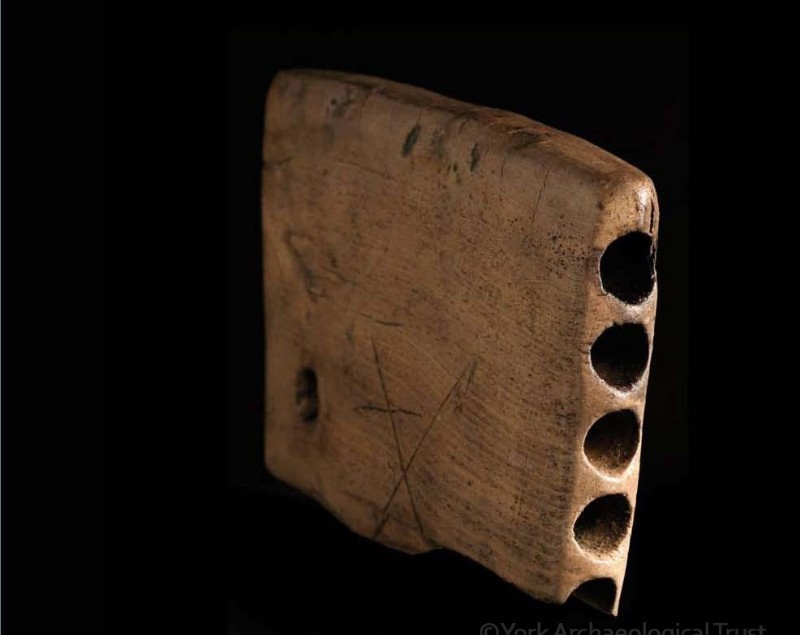
One of the more sophisticated instruments found was a 9th/10th century panpipe (pictured) found in York. This was made of boxwood and the holes in it were skilfully drilled to give a tunable finished instrument. The most complex instrument of the time was the organ. No archaeological remains survive, although there is documentary evidence in Winchester for an organ operated by manual bellows and slider. Lucy-Anne showed us a replica and demonstrated the kinds of sounds it might have made.
The next meeting of the Group will be held on Tuesday 3 March, when the AGM will take place, followed by presentations by members of the committee on bioarchaeology and the Group’s archives.


Leave a Comment
Want to join the discussion?Feel free to contribute!