
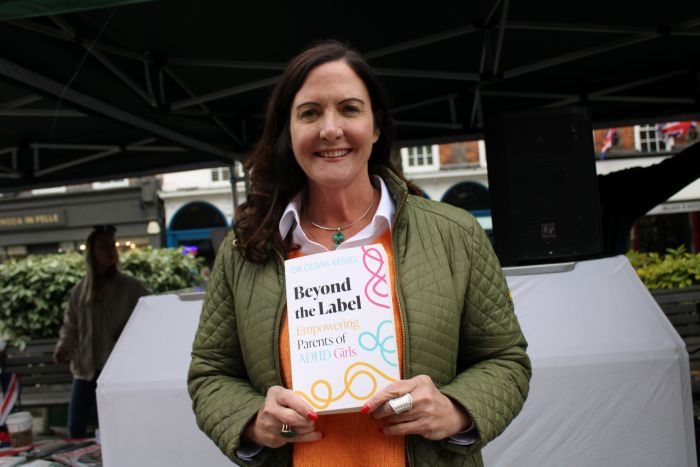
Local doctor reveals why ADHD in girls is so often missed in new book
A new book Beyond the Label written by local doctor Olivia Kessel explores the often-overlooked signs of ADHD in girls after her own daughter Alexandra’s struggles pushed her nearly to breaking point.
The book offers practical insights, compassionate support and a roadmap to help you and your child with ADHD. It provides readers with actionable tools and emotional support.
Olivia, founder of the SEND Parenting Podcast, said she decided to write the book after hearing experiences of other mothers that she first began to suspect Alexandra had ADHD. “The penny dropped,” she said. “I started wondering if she had ADHD, because girls can present in very different ways from the stereotype of the hyperactive little boy.”
“Instead of becoming more independent as she got older, things unravelled faster than I could catch my breath. Each day, the gap between what I hoped for her and what we were facing seemed to widen, leaving me trapped in a cycle of questions I could not answer: why was she struggling with simple things that other children her age could do without a second thought?”
“Our relationship felt like it was falling apart. Other children her age were making their own lunches and becoming independent, while we felt like we were walking through a field of grenades, never knowing when or where the next explosion would happen.”
She said puberty can intensify symptoms in girls due to hormonal changes. “When oestrogen starts to kick in during puberty, it can play havoc and turn up the volume on ADHD,” she explained. “As girls enter adolescence, fluctuations in oestrogen may heighten emotional sensitivity and mood changes, exacerbating challenges with attention and impulse control.”
Olivia said receiving the diagnosis brought both relief and fear. “When I was called with the diagnosis, I was seesawing between thinking, ‘great, now we know’, and ‘what do I do now?’” she said.
The book also explores topics Olivia believes are often overlooked in ADHD particularly emotional dysregulation and sleep difficulties. “Who knew sleep problems were so connected with ADHD?” she said. “My daughter couldn’t get to sleep at night, and we didn’t understand why for so long.”
The writing process itself was a challenge, and it took a year getting up to write before Alexandra got up for school at 6am. Olivia, who is dyslexic, said she never imagined she would become an author. “Until university, I would simplify my writing because I couldn’t spell many words,” she said. “Tools like Grammarly really helped me write this book. The challenge was all the reiterations – you think you’re done, then the publisher comes back wanting more changes, fixing references and checking every detail.”
Olivia believes her perspective as both a doctor and a mother sets the book apart. “There are brilliant books written by doctors, but they don’t always have the Mum lens or the lived-through-it lens,” she said. “I wanted to look at girls differently.”
A key aim of Beyond the Label is to give parents practical hope. “I hope it offers hope above all else,” Olivia said. “Things really can improve.” She describes moving from “a really dark place to a really light place” after learning how ADHD affects the brain and adapting her parenting approach accordingly.
Beyond the Label is available to buy at the Bell Bookshop.





Leave a Comment
Want to join the discussion?Feel free to contribute!