
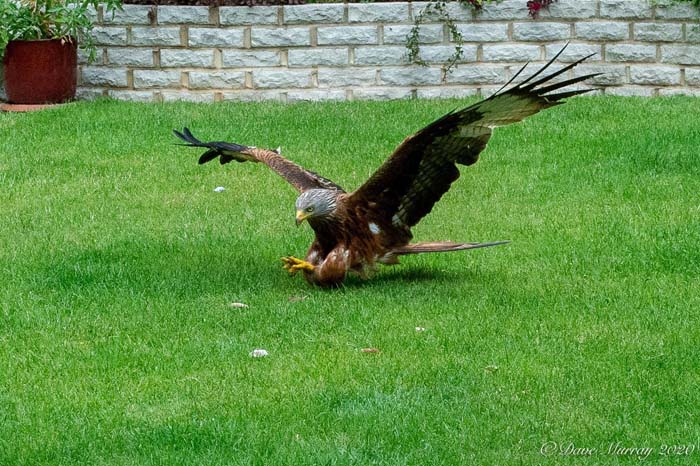
Turning Back Time 2021 – Red Kites Scaring Residents & Little Boy Hurt
This news story from 2021 about the Red Kites continues today with residents being regular alarmed by Red Kites swooping for food. We’ve chosen this story this year because it was story that went national from being published on the Herald. Most of the article was reproduced in The Times and Adrian Chiles’ team from Radio 5 contacted us to see if we could put them in touch with Anna and Trevor Howell. Anna did an interview with Adrian afterwards.
Red Kites Scaring Residents by Swooping for Food
We are blessed in Henley to see the stunning Red Kites who were reintroduced into the Chilterns by RSPB and English Nature (now Natural England) in the early 1990s after being extinct however some residents are now being scared and feel threatened by these large birds swooping down in their gardens and scavenging for food.
Anna and Trevor Howell who live on Makins Road had a recent problem with a Red Kite. Anna explained, “We had a bit of a scare a couple of weeks ago when a Red Kite swooped down and skimmed the top of my head, trying to pinch the smoked mackerel from my salad. I retreated indoors and it then tried the same thing on Trevor! Whilst we love watching them, it’s very scary having such a large bird at such close quarters. I mentioned it on our neighbourhood forum and couldn’t believe how many other people have had similar experiences recently – hot cross buns snatched from people’s hands, steaks snatched from barbecues, one woman hit on the head by the bird’s wing giving her a headache for several days. We all feel that the problem is that some local people feed the Red Kites so that they can photograph them close-up. We see them swooping down into their gardens. All the advice from wildlife organisations like RSPB is never to feed them.”
Red kites were driven to extinction in England by human persecution by the end of the nineteenth century. A small population survived in Wales, but there was little chance of these birds repopulating their original areas. Between 1989 and 1994, kites from Spain were imported and released into the Chilterns. Red kites started breeding in the Chilterns in 1992 and now there could be over 1,000 breeding pairs in the area. The reintroduction has been so successful it is not possible to monitor all the nests, so the overall size of the population can only be estimated. Since 1999, chicks have been taken from the Chilterns to reintroduction sites in other parts of the country.
Anna contacted the RSPB and received a reply from Karolina Roszkowska who said, “Red kites are fantastic birds of prey. Even 20 years ago, very few people would have the opportunity to see them. The fact that so many of us now can is a brilliant conservation success we can all celebrate. Red kites are primarily scavengers who travel far and wide in search of food. They rarely have any problem finding dead animals and other things to eat, so there is no need for people to be putting out food for them. Although feeding red kites isn’t illegal, we encourage people not to put meat out in gardens to provide their kites, as there is no need. There is plenty of food for kites, and people can get great views of them in lots of places. They can and will take live prey, notably small mammals such as mice and voles, particularly at certain times of the year. Regular feeding of kites could ultimately lead to an unsustainably high population of red kites, reliant on human hand-outs. It can lead to kites getting used to approaching and taking food from humans.”
Little Boy Hurt by Red Kite
After publishing an article about Red Kites causing problems last week to a number of residents, this week on Monday the situation has taken a more serious turn with a young child being hurt by one.
Frankie Bird, aged 2 was waiting with his Grandma in his pushchair to collect his older brother outside Valley Road School at 3.15pm when a Red Kite swooped down and took his custard cream biscuit he was eating and scratched a deep cut into his hand with his claws.
Frankie’s Mum, Hannah explained, “My mother-in-law who was holding the pushchair was really scared. The Red Kite dropped some of the biscuit and thought my little boy still had it and kept swooping down which was really scary. After trying to wave the kite away and putting up the pushchair cover to protect Frankie the bird finally realised that the rest of the biscuit was on the ground and picked it up and flew off.”
Hannah’s sister-in-law called Townlands Hospital to see whether she should bring Frankie in as she thought he might need a tetanus injection. Hannah comments, “Luckily he didn’t need an injection and they cleaned the wound really well with some iodine before dressing it. Frankie’s hand was quite red and angry looking. He also took a little while to settle to go to sleep that night. I think he was lucky as it could have been much worse.”
The advice from the RSPB is, “Red kites are fantastic birds of prey. Even 20 years ago, very few people would have the opportunity to see them. The fact that so many of us now can is a brilliant conservation success we can all celebrate. Red kites are primarily scavengers who travel far and wide in search of food. They rarely have any problem finding dead animals and other things to eat, so there is no need for people to be putting out food for them. Although feeding red kites isn’t illegal, we encourage people not to put meat out in gardens to provide their kites, as there is no need. There is plenty of food for kites, and people can get great views of them in lots of places. They can and will take live prey, notably small mammals such as mice and voles, particularly at certain times of the year. Regular feeding of kites could ultimately lead to an unsustainably high population of red kites, reliant on human hand-outs. It can lead to kites getting used to approaching and taking food from humans.”
Hannah added, “I’ve got nothing against Red Kites, they are brilliant birds. I’m worried that if people keep feeding them in residential areas, there’s going to be a bigger problem. I wanted to highlight this so that people are more vigilant. When I took Frankie to Townlands they said it is becoming a more a regular thing as the birds are becoming braver and more brazen.”


Leave a Comment
Want to join the discussion?Feel free to contribute!