
Report on Hospital Discharges Recommends Improvements Needed
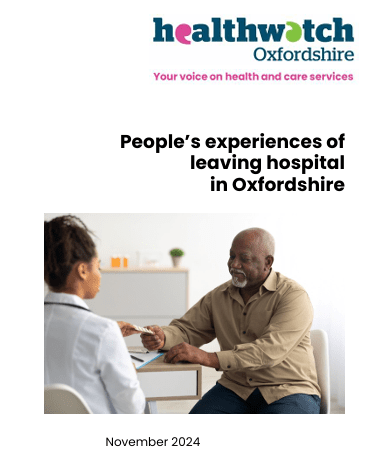
A report by Healthwatch Oxfordshire has been published on people’s experiences of leaving hospital between March and September 2024 which recommends improvements.
A new Discharge to Assess (D2A) scheme was launched in November 2023 and is a partnership programme, involving staff from Oxfordshire County Council, Oxford University Hospitals NHS Foundation Trust, Oxford Health NHS Foundation Trust and Age UK Oxfordshire, working together to identify the best way of supporting a patient to leave hospital safely and quickly. This scheme was one of the reasons given by Buckinghamshire, Oxfordshire & West Berkshire Integrated Care Board (BOB ICB) and Oxfordshire County Council for removing the 7-step down care beds at Chilterns Court Care Centre.
Over 100 people are being discharged home each week across Oxfordshire. The latest figures demonstrate it has enabled 23% more people to leave hospital compared to last year. In October, this amounted to 657 people going home from hospital through Discharge to Assess. 293 people completed a survey on their experience with most common postcodes in Banbury, Oxford, Wantage
and Henley. 115 people who completed the survey said they left hospital needing no support, 26 needing additional support under D2A and 3 went into a community hospital. 69% of people were aged 65+.
16 people (84%) of respondents to the online survey who got additional care and support at home, said they agreed or strongly agreed to the statement ‘I felt happy to be home’.
A narrow majority of people gave positive responses (agree or strongly agree) to statements about conversations with health professionals about leaving hospital, but there was also a significant proportion who gave negative responses – particularly to statements about involving family or carers in decisions (47 people out of 102, 46% said ‘disagree or strongly disagree’), whether health or social care professionals had explained what would happen after the person left hospital (46 people out of 108, 43%), and who to contact if they had any problems after leaving hospital (41 people out of 118, 35%).
Half of online survey respondents who received care at home said they disagreed or strongly disagreed that health and social care professionals communicated effectively with each other about their care and more than half (10 out of 17, 59%) disagreed or strongly disagreed with the statement ‘I felt that health and social care professionals worked together to support me in a joined up way.’
For Pathway 0 patients (leaving hospital without support needed) who shared their experiences one of the most common issues was around a lack of follow-up care or aftercare from primary
care, community services or hospital outpatient care, after leaving hospital.
Only half the respondents who were D2A said they were happy with the quality of care and support they go and how health and social care professionals communicated with them about
their care. Less than half said they felt safe (7 out of 15 people, 47%). Several D2A patients said that after they were medically ready to go home, there were delays while a package of care was put together.
Around half the online survey respondents said ‘They involved my family or carers in decisions about me leaving hospital.’ Out of 23 unpaid carers, 12 carers said they were not offered support.
One of the most common negative comments about care was around the timing of visits from carers from home care providers. Patients are usually allocated a four-hour time window for each visit. This can make care unpredictable, disrupt people’s routines, is not always patient centred, and can increase pressure on unpaid carers, including them taking on more of a caring role in order to maintain the person’s routine.
Oxfordshire County Council and BOB ICB, visited Henley during the Health and Social Care Connections events twice, speaking with 58 people. The second event was held at the Over 60s social club in October. One man (‘R’) who had, in the last few weeks, been in a hospital in Oxford. He commented that: “Home First [the council’s reablement at home service] is good. I’ve had no problem with that whatsoever.” Another woman (‘M’) mentioned that she fell down the stairs at home in February. She was admitted to hospital and discharged through Home First. When she arrived home, her bed was downstairs and a commode had been put in place. M said: “It was brilliant. I couldn’t have come home without it”. “I thought, I can’t go home, but I did and I’m now independent and still living at home.” She also mentioned the great RACU service at Townlands, saying that on the first day, she found it difficult going into Townlands, so on subsequent days, they went to her. “It was so much easier.”
The Healthwatch Oxfordshire report includes some recommendations, including improvements around the continuity and quality of care experienced by patients, clearer communications for patients and carers, and better support and identification of unpaid carers.
The report goes on to recommend the continued close working relationship between health and social care partners to further improve the hospital discharge process.
Dan Leveson, Oxfordshire Place Director at BOB Integrated Care Board, said: “It’s relatively early days for Discharge to Assess but we’re already seeing its benefits, helping people leave hospital more quickly, offering them an even better chance to regain their independence.
“We recognise that improvements still need to be made to ensure everyone has a positive experience of being discharged from hospital.
“We thank Healthwatch Oxfordshire for the valuable insights we have gained from their report and look forward to continuing to work with health and social care partners to build on our early success.”




Leave a Comment
Want to join the discussion?Feel free to contribute!