
Wildlife Words: Trees in Autumn
It’s that time of year when the trees will be changing colour, the air is getting colder and fresher, and we can’t help thinking of warm drinks, cosy clothes and playing in the crunchy leaves.
As we enter Autumn, it can be tempting to cut back all the dead and dying vegetation in our gardens and green spaces. It’s worth considering that many of these woody stems will become perfect winter homes for insects as they enter hibernation and can create areas of architectural beauty in our homes and communities.
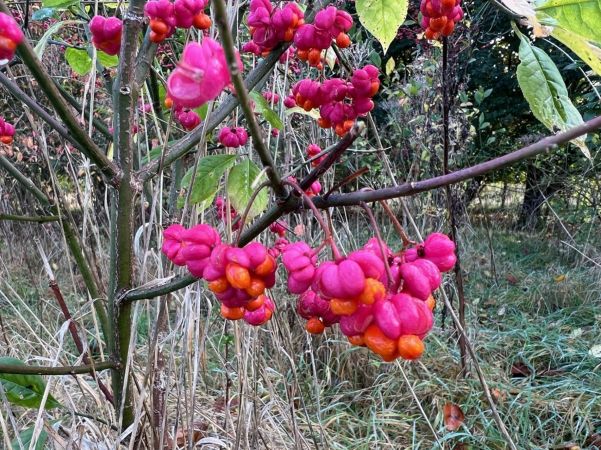
In Oxfordshire, the hedgerow species we generally recommend planting (for their capacity to provide for both people and wildlife year-round) and you’re most likely to see in your local area include Blackthorn, Spindle, Common Buckthorn, Guelder Rose, Wild Privet, Cherry Plum, Dog Rose and Hazel. Fruiting season for many of these species starts from late summer to early autumn. As such, by this time of year, most of the species listed above will be fruiting. Hawthorn berries have traditional use in heart-strengthening natural medicines but also act as a vital source of food for caterpillars, moths, and migratory birds. Keep your eyes peeled for spindle, which has vibrant autumnal colours with vibrant pinks, and the leaves turning from a deep green to a beautiful red.
Riverside trees
The native white, crack, pussy, osier and goat willows are a familiar sight along the Thames and its tributaries. Willows provide shelter for birds, mammals, including bats, otters and water voles. Their leaves are the larval foodplant of the Purple Emperor, Large Tortoiseshell and Comma butterflies and their catkins the earliest sources of food for bees. Both the male and female flowers (catkins) carry sugary nectar, and the male flowers also carry protein rich pollen, which is so important for developing bee larvae. Willow nectar is also a major energy source for Blue Tits during early spring.
Traditionally managed by ‘coppicing and ‘pollarding’, mature trees can be cut to form a thick stump or ‘coppice stool’ that considerably extends the life of the tree and lets in light to the shrub layer. Some Crack Willow pollards are known to have lived for 1000 years. Willow is also a useful hedge plant in damp conditions.
Trees for Bees
Trees are an important, stable long-term source of food for bees and other pollinators, providing thousands of flower heads all in one place. Plant a variety of tree species selected to benefit bees and other pollinators, with species that flower at different times of the year to provide nectar, pollen and nesting sites as well as offering a haven for other wildlife and cleaning the air and water and storing carbon. Check out the guidance on our website for more information: https://www.wildoxfordshire.org.uk/guidance/tree-planting-guidance
Hedgehog Friendly things to do this autumn and winter
- Put out a shallow dish of water or make sure your ponds are easy to get out of for hedgehogs (shallow edges or a platform / ramp), so they have water to drink
- Leave a wild patch each year with piled up logs or leaves that you don’t disturb
- Always move your burn piles before you light them as hedgehogs and frogs often use them to sleep in (this is, after-all, how hedgehogs were once upon a time cooked to be eaten!). Thankfully it is now illegal to eat this endangered species
- Avoid using pesticides or herbicides as this will make hedgehogs very ill. Find out more here hedgehogrescue.org.uk/hedgehog-friendly-slug-pellets/
- If you want to put out food, cat or dog food is best
- If you find a sick or injured hedgehog, or one up and about during the middle of the day, call Tiggywinkles Wildlife Hospital on 01844 292292
Imogen Parker, Wild Oxfordshire Community Ecologist
www.wildoxfordshire.org.uk/




Leave a Comment
Want to join the discussion?Feel free to contribute!