
The River Towns of the Middle Thames: A Shared Heritage
Between Mapledurham and Windsor, the River Thames flows through a landscape shaped as much by human endeavour as by water and time. Here, the river is not merely a scenic presence but the organising force behind settlement, trade, faith, industry and power. Each town along this reach has its own distinct character, yet all share a common inheritance: they exist because of the Thames.
At Mapledurham, the river is still unmistakably a working presence. For centuries, Mapledurham Mill has harnessed the Thames to grind grain, supplying local communities and distant markets. The weir, mill race and carefully managed water levels speak of a time when the river was an economic engine, its flow governed with skill and respect. Mapledurham House and its estate were shaped by this relationship, with water routes as vital as roads. That the mill continues to operate today offers a rare and tangible link between the modern Thames and its industrious past.
Downstream at Reading, the Thames underpinned the rise of one of the region’s most important inland towns. Long before railways and factories, Reading prospered as a river port, its wharves busy with barges carrying grain, timber and stone. The founding of Reading Abbey in the 12th century cemented the town’s importance, with the Thames and Kennet providing food, materials and connection to London. Though much has changed, the river corridors still trace the outlines of Reading’s earliest working life.
Further along, Henley-on-Thames presents a familiar yet layered story. Known worldwide today for rowing and regatta, Henley was once a bustling trading town, its prosperity built on river traffic. Malt, grain and timber moved steadily downstream, shaping streets, inns and livelihoods. In the 19th century, Henley’s relationship with the Thames evolved, as leisure and sport began to share space with commerce. The river became a stage, but it never ceased to be the foundation upon which the town rested.
At Marlow, the river’s importance is rooted in connection. A crossing point since early times, Marlow relied on ferries long before its bridge unified both banks. The Thames supported mills, fisheries and riverside crafts, sustaining a close-knit working community. Later, the town drew writers, artists and visitors, inspired by the gentle reach of river and landscape. Despite this change, the Thames remains Marlow’s centre of gravity, binding past and present together.
In Cookham, the Thames takes on a more spiritual dimension. An important Anglo-Saxon religious centre, Cookham has long been regarded as a sacred riverside place. This sense of continuity and meaning was later captured by artist Stanley Spencer, who saw the everyday life of the village and river as something eternal. Meadows, paths and watercourses here have altered little over centuries, reinforcing the feeling that the Thames is not simply passing through, but holding the place together.
At Maidenhead, the story is one of industry and innovation. The Thames supported brickmaking, milling and trade, while also shaping transport routes. The arrival of the Great Western Railway brought Brunel’s remarkable bridge across the river—an elegant union of engineering and landscape. Maidenhead became a meeting point of river, road and rail, its growth tied closely to the Thames’ enduring role as a corridor of movement and exchange.
Finally, at Windsor, the Thames flows through power and pageantry. For centuries, the river served the castle as a strategic and ceremonial highway, carrying monarchs, courtiers and supplies between Windsor and London. Royal barges once glided along its surface, projecting authority downstream. Yet Windsor’s Thames was never solely regal; it remained a working river, supporting fishermen, boatmen and traders whose lives unfolded alongside the great affairs of state.
Taken together, these towns tell a shared story. The Middle Thames is not just a sequence of picturesque places, but a living historical system—worked, managed, celebrated and revered. To understand this stretch of river is to recognise that its heritage lies not only in buildings and events, but in the continuous relationship between water and people, flowing steadily from past into present.
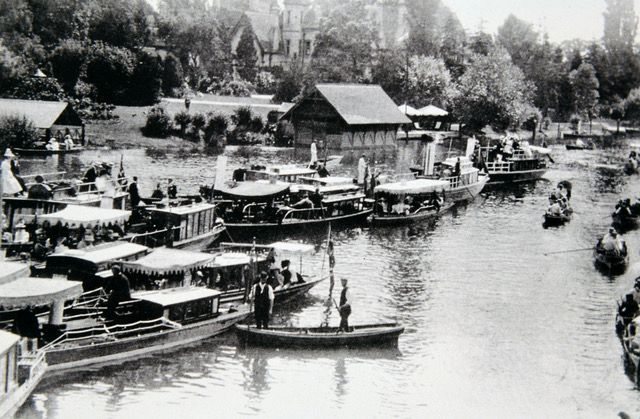
The photograph shows a scene from the river and comes from the River Thames Society archives. Could it be Bisham Abbey in the photograph? Leave your comments below…
This article was written by the River Thames Society who aim to protect our heritage as well as preserving and promoting our wonderful river throughout the year. Greg Wilkinson from the River Thames Society said, “We believe that the River Thames is entrusted to our care and that we have a duty to ensure that it is preserved and protected for the generations who follow us. The Middle Thames Branch (Voice of the Thames on social media) is seeking to make a real difference by pulling together all those who share our passion and our sense of duty. Join us and be part of the difference. www.riverthamessociety.org.uk/join-us.”





The view is from the road just downstream of Boulters Lock, over the Ray Mead Hotel pontoons secured to big timbers, towards Taplow Court, which can be seen on the far bank. see https://www.thames.me.uk/s00728.htm
Great article!
Thank you for your very helpful comment John. I had thought it might be Bisham but your observations are clearly more accurate. Glad you enjoyed the article.
This is one of the series of well-known photographs of Boulters lock on Ascot Sunday A highlight of the social calender.The majority of the passenger steamers were owned by Bonds of Maidenhead but it was common on this Sunday for downriver boats to be hired for hospitality. Boulters was the place to be seen and crowds would pack the steps ro catch a glimpse of the celebrities of the day including the occasional Royal