

Screening of climate film sells out as second showing announced
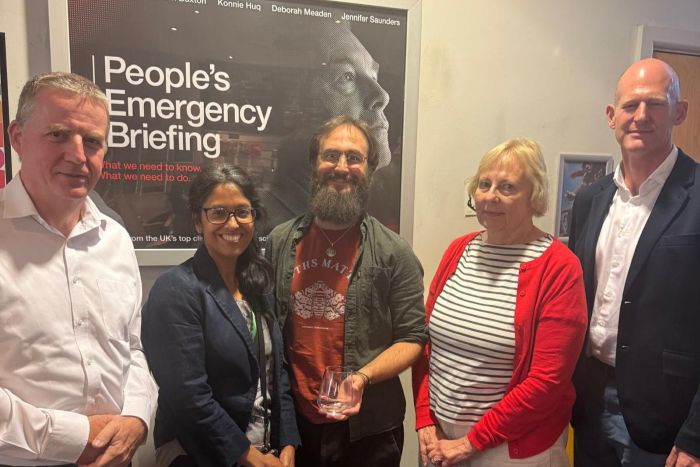
Demand for Henley’s first public screening of The People’s Emergency Briefing has prompted Greener Henley and the Regal Picturehouse to plan a second showing on Monday 24 August, after the original event sold out as the town experienced yet more extreme heat.
Nearly 80 people packed the Regal Picturehouse last Monday for the screening, which formed part of a growing nationwide programme of community events encouraging people to better understand the climate and nature crisis and explore practical ways to strengthen local resilience.
The film is based on the National Emergency Briefing held in London last November, where leading experts presented evidence on the climate and nature crisis to an audience of national decision-makers, including more than 100 Members of Parliament.
More than 2,500 screenings of the film have since taken place in communities across the UK and beyond, bringing people together to discuss climate resilience in the face of escalating impacts, including the recent extreme heat.
The film explains how climate and nature breakdown is affecting health, food security, national security and the economy, while presenting practical and positive solutions.
Greener Henley previously organised an invite-only screening in June as part of its Community Resilience Briefing, which brought together more than 100 local leaders from across the community and was widely praised by those who attended.
Following the screening, a panel discussion chaired by Giles Trendle, trustee of Greener Henley and co-chair of Covering Climate Now, explored what these global challenges mean at a local level. Joining him were Nick Armitage, Head Teacher of Rupert House School; Rebecca Chandler-Wilde, Chair of Henley Town Council’s Climate and Nature Emergency Advisory Group (CANEAG); and local entomologist Phil Bruss.
Nick Armitage spoke about the important role schools play in preparing young people for the challenges ahead, highlighting Greener Henley’s Green Futures Awards and revealing that Education Henley is planning its own screening for parents to encourage age-appropriate conversations with their children.
He also described the practical impacts rising temperatures are already having on schools.
“The recent heatwaves have brought huge challenges to every education setting,” he said. “Every school has had to adapt. It has a huge impact on children’s development.”
Rebecca Chandler-Wilde outlined Henley Town Council’s commitment to tackling the climate and nature emergency, including work to reduce the carbon footprint of its buildings and operations.
The discussion also highlighted the importance of protecting nature as an essential part of the town’s resilience. The film explains how healthy ecosystems help reduce the impacts of extreme heat, flooding, food insecurity and economic instability.
Using a vivid analogy, Phil Bruss described the interconnectedness of the natural world.
“Species are connected to others like the knots in a hanging fishing net,” he said. “Breaking those connections can make the net hang in unexpected ways, changing species behaviour, while making whole areas of the net less stable and less functional.”
Bruss emphasised the vital relationships between pollinators, healthy soils, insects and wider ecosystems, and encouraged people to reconnect with nature rather than becoming increasingly disconnected from it.
The second screening of The People’s Emergency Briefing will take place at the Regal Picturehouse on Monday 24 August at 6.00pm. Tickets will be available through the Regal Picturehouse website.




Muppetry. Oh, and three days ago we had the Earth’s lowest ever temperature recorded in the Antarctic.
I’m clearly an idiot. I apologise for my previous post where I didn’t understand what climate change means. Not only was every aspect of what I wrote wrong (The lowest temperature ever recorded on Earth came from Russia’s high-altitude Vostok weather station in East Antarctica, which experienced minus 128.6 degrees on July 21, 1983. The Antarctic Interior reached Minus 119.4 Degrees Fahrenheit, Earth’s Lowest Recorded Temperature in More Than a Decade)
I’ll try harder to research anything I post in future, or maybe I’ll keep posting nonsense.